Superconductivity
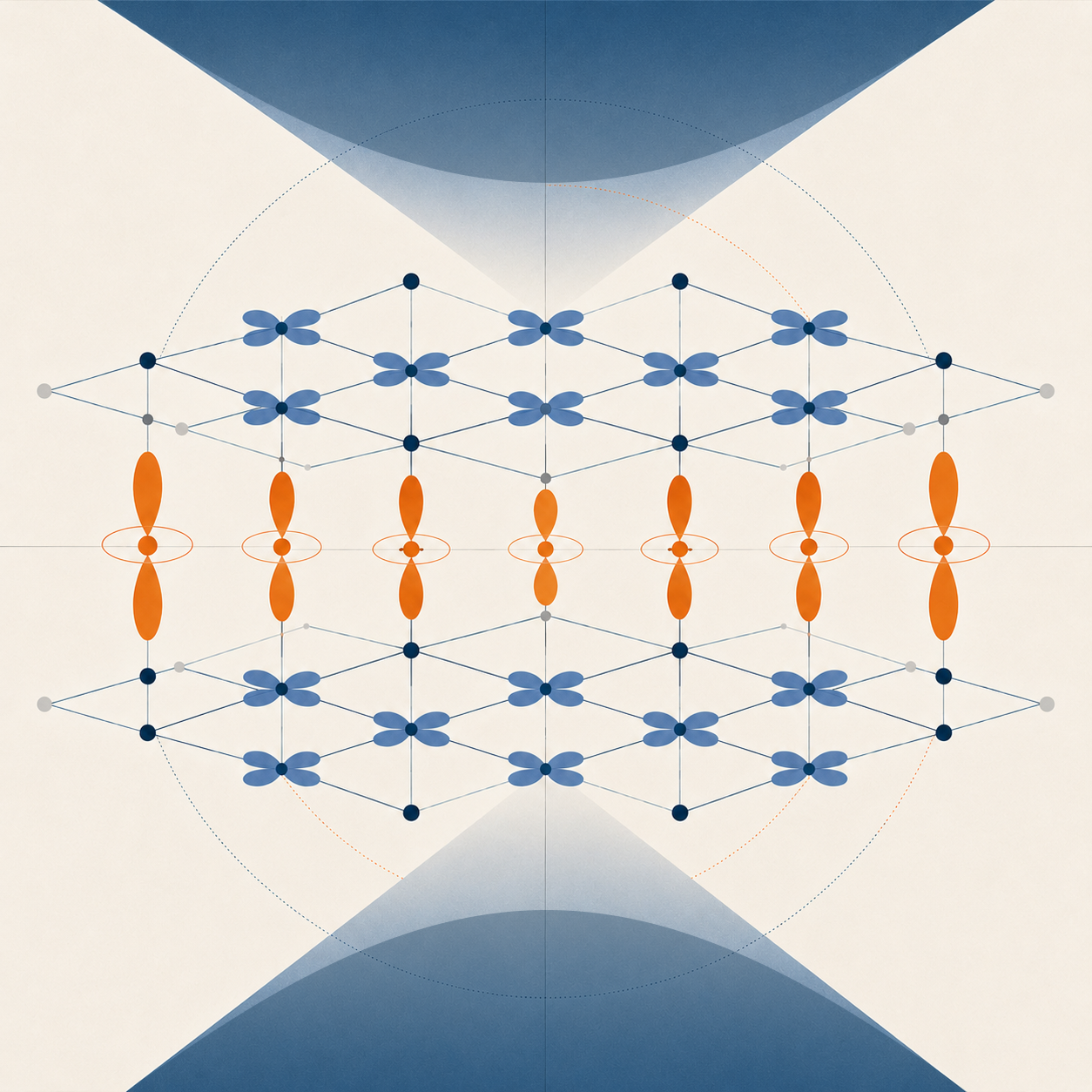
Mott to superconductor
How doping a featureless Mott insulator yields high-temperature superconductivity and explains pressure effects in bilayer nickelates.
JW DLMLZZWHFYYY
In press npj Quantum MaterialsDLMLZZWHFYYYThe London Institute’s papers are the official record of our discoveries. They allow others to build on and apply our work. Each one is the result of many months of research, so we strive to make them clear, inspiring and beautiful, and publish them in leading journals.
How doping a featureless Mott insulator yields high-temperature superconductivity and explains pressure effects in bilayer nickelates.
DLMLZZWHFYYY
Charge-conjugation, space-parity and time-reversal symmetries are shown to form noncommutative groups, including the order-16 Pauli group.
ZWSYYY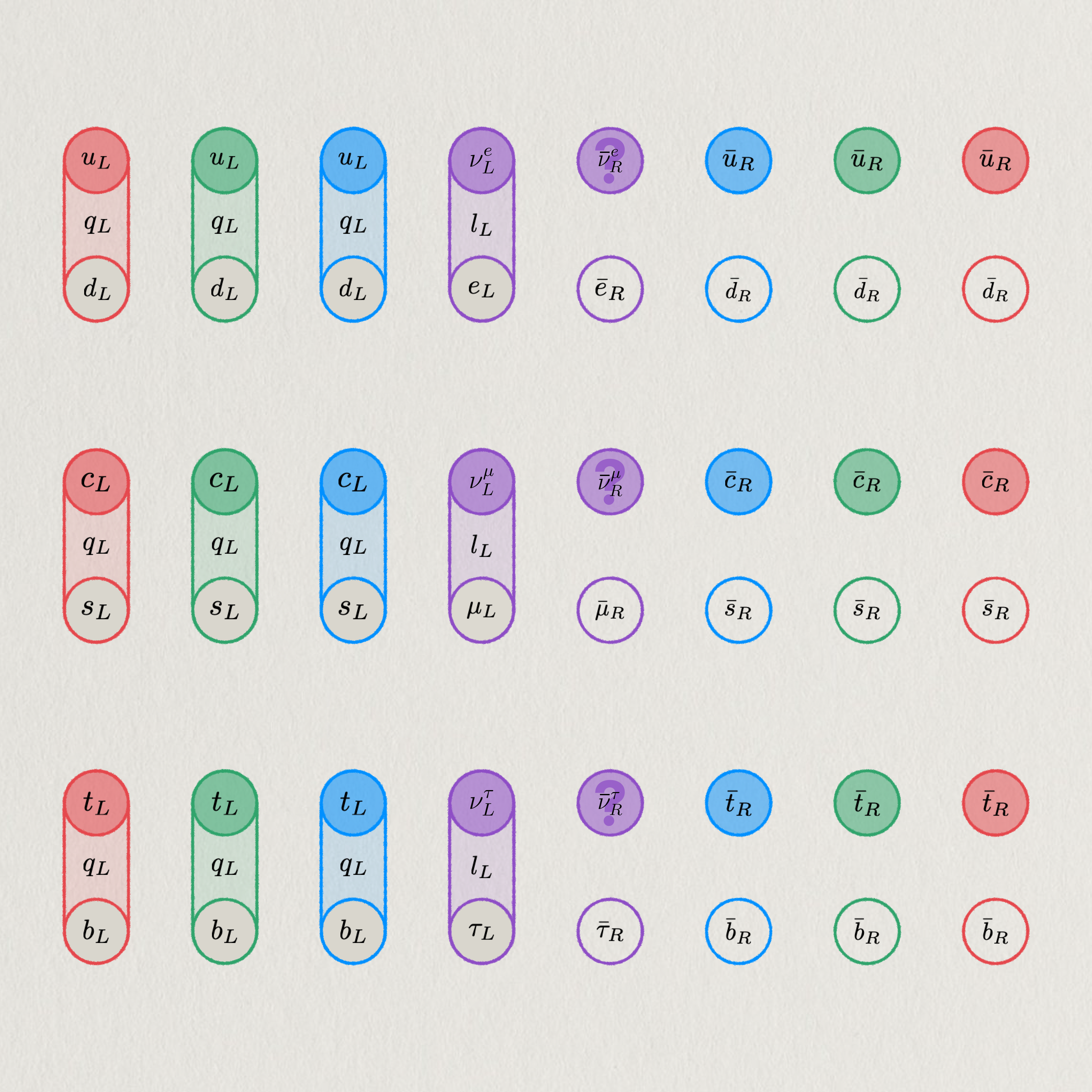
A colour symmetry extension of baryon plus lepton symmetric gapped quantum topological order replaces families of massive sterile neutrinos.
ZWSY
We propose that dark matter consists of topological order, so gapped anyon excitations decay to generate the Standard Model's lepton asymmetry.
Varying the spacetime dimensions fermions occupy shows charge-conjugation C, space-reflection R and time-reversal T symmetries are 8-fold periodic.
Extending family symmetry by colour cancels a Standard Model global anomaly, linking three colours to favour three fermion generations.
We show that Weyl fermions and anomalous topological order in 4 dimensions can live on the edge of the same 5-dimensional superconductor.
Fractional conductivity between the nuclear and electromagnetic higher symmetries reveals four global Lie gauge groups of the Standard Model.
With IBM Quantum, we braid non-abelian Fibonacci anyons in string-net condensates to realise fault-tolerant universal quantum computation.
Sterile neutrinos are replaced by topological order as dark matter candidates to counterbalance the Standard Model’s gravitational anomalies.
Gravitational anomalies causing baryon and lepton number violation in the Standard Model are resolved using new fermionic topological orders.
We demonstrate that the Standard Model's baryon minus lepton symmetry defect can become categorical by absorbing the gravitational anomaly.
Charge conjugation C, space reflection R, and time-reversal T operators are regularised in a quantum many-body Hilbert space on a discrete lattice.