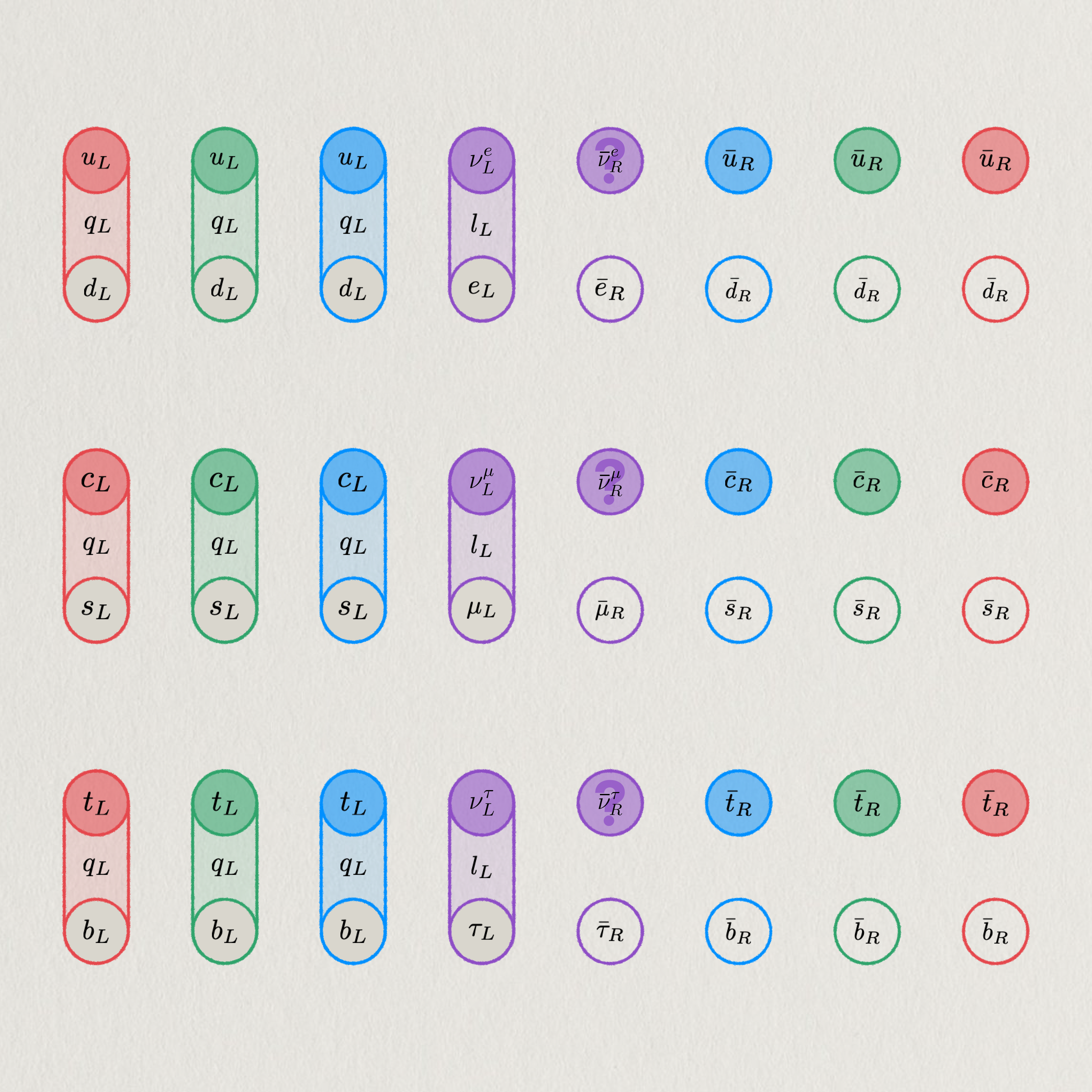
Three fermion families
Family puzzle asks why the Standard Model (SM) features exactly 3 families of quarks and leptons. Motivated by topological constraints, we study 4-dimensional fermionic anomalies with discrete Zn symmetry, classified by the 5d spin bordism group. We show that only the group-cohomology subclass H5(Zn,U(1))≅Zn can be canceled by an anomalous Zn-symmetric 4d Zn-gauge topological quantum field theory (TQFT), while beyond-group-cohomology AZnp1 involving the Pontryagin class p1 cannot (except n=2,3). More generally, we prove that any cocycle αd∈Hd(Zn,U(1)) in odd spacetime dimension d≥3 is trivialised by the symmetry extension 1→Zn→Zn2→Zn→1, and we construct the corresponding symmetric anomalous boundary TQFT. For d=5 and n=3, this yields a Spin×Z3-symmetric 4d Z3-gauge TQFT that cancels the mixed discrete (B+L)-gauge-gravitational anomaly of the SM in the absence of 3 "sterile" right-handed neutrinos νR. We further analyze a generalized SM with Nc colors and Nf families and argue that missing Nf copies of the νR can be naturally replaced by that 4d anomalous Spin×ZF2Z2Nf,B+L symmetric ZNc-gauge TQFT under the anomaly cancellation, via an appropriate ZNc-color symmetry extension construction 1→ZNc→Spin×ZNcNf→Spin×ZF2Z2Nf→1 of anomalous topological order. For minimal nonzero positive integers Nc and Nf, we find the minimal color extensions: Nc=3,Nf≥3; Nc=4,Nf≥2; and Nc=12,Nf≥6. If we further require that an SM baryon is a fermion so Nc is odd, then ZNc=Z(SU(Nc)) color center, we prove 3 families and 3 colors, Nc=Nf=3, is the unique case that stands out. We also prove that AZ3p1=0mod3 for the mod 3 cohomology class in an appropriate context.
Arxiv (2026)