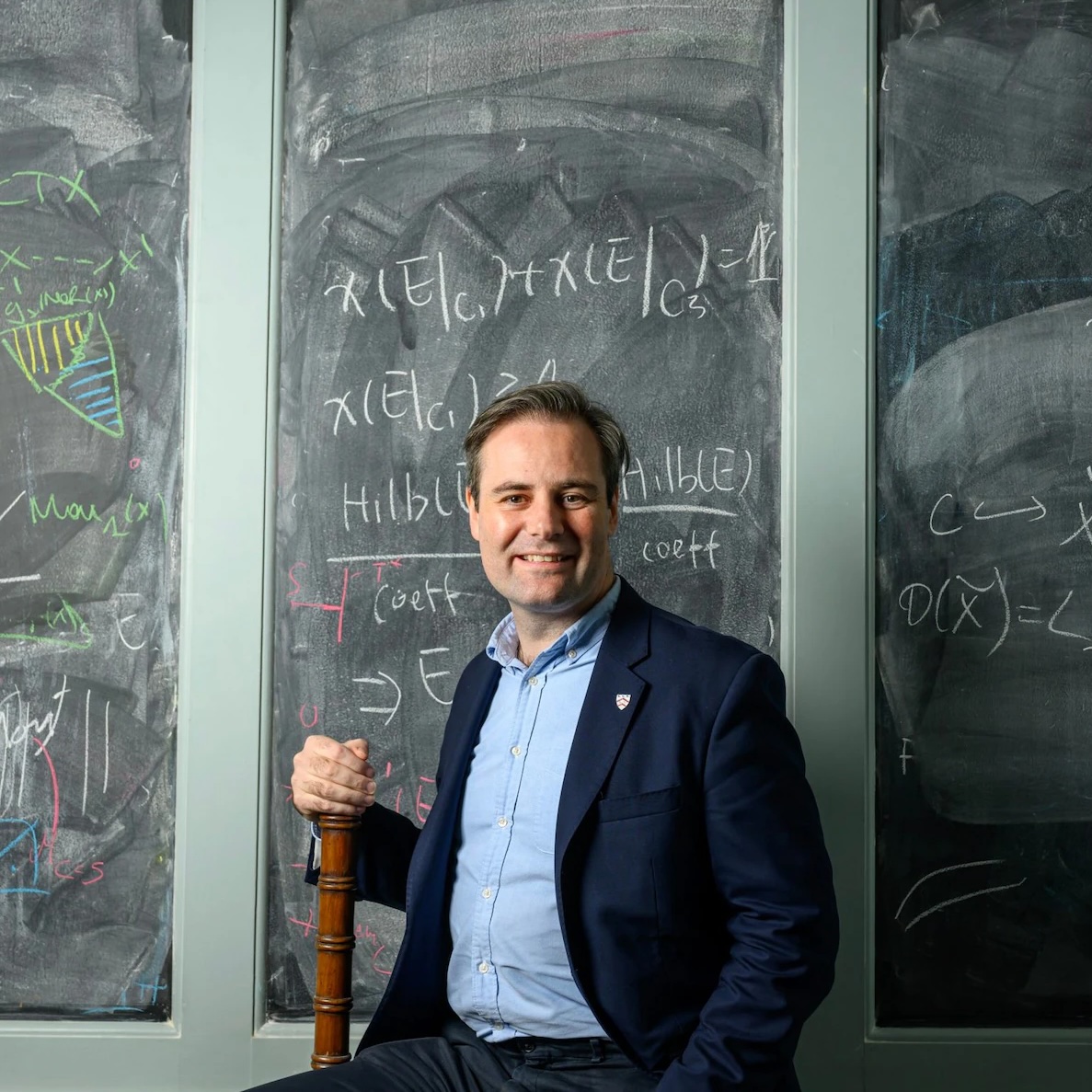
The British crypto billionaire funding free speech battles against the police
The Sunday Telegraph, 7 Dec 2025
Our trustee Ben Delo talks to The Sunday Telegraph’s James Titcomb about how he went from bitcoin billionaire to free speech philanthropist.
Ben Delo had become used to being in trouble. Growing up in Oxford, he was expelled from three separate primary schools – in one case for vandalising the teachers’ toilets.
After being diagnosed with Asperger’s and receiving specialist support, his mathematical talents landed him a place at Oxford, where he was almost kicked out for internet piracy.
His fellow students at Worcester College voted him the most likely to become a millionaire – and the second most-likely to go to jail.
So in 2020, when the US government charged Delo and his fellow founders at his cryptocurrency company BitMEX with breaking anti-money laundering laws, it was not his first brush with those in authority.
Delo pleaded guilty and paid a $10m (£7.5m) fine as part of a settlement – but earlier this year he was pardoned by Donald Trump, who has embraced a pro-crypto stance, loosening regulation and undoing many of the White House’s previous prosecutions.
“I’d been through a lot more challenges and difficulties in my life than the US government,” says Delo.
“I’m very grateful to Trump for the pardons ... but I would like to be known for my actual achievements and actions, rather than some spurious blip running a start-up.”
In 2018, Delo became Britain’s youngest self-made billionaire as well as its first Bitcoin billionaire through BitMEX, the Hong Kong-based exchange that used to see billions in cryptocurrency futures traded each day.
He is now using his wealth to fund a series of philanthropic ventures including a free speech movement in Britain, railing against what he calls “authoritarianism”, which has led to thousands arrested for social media posts.
Many people with Asperger’s struggle to engage with the inconsistencies and grey areas of everyday life.
The 41-year-old has channelled that into a pursuit of truth that he sees as being under attack from political correctness, and incompatible with the idea that voicing opinions can be a crime.
Having vowed to give away at least half his fortune, Delo has helped fund Lord Young’s Free Speech Union and the Committee for Academic Freedom, which campaigns against speech restrictions in universities.
He is also friends with Right-wing academic Jordan Peterson, with the two watching the Queen’s funeral from Delo’s office near Westminster Abbey.
“I’d always just taken for granted that as a British citizen, we had rights ... freedom to enquire, freedom to think, freedom to speak,” Delo says.
“I’m almost a reluctant philanthropist, because to me, this should be something that’s a constitutional principle. The Government should be defending this, not attacking it.
“It unfortunately comes down to individual philanthropists to help defend it.”
Delo says his interest in the cause was piqued by the case of Paul Chambers, who was found guilty and later cleared for a tongue-in-cheek 2010 tweet saying he would blow up an airport if his flight was cancelled.
Since then, a spate of arrests for social media posts has only strengthened Delo’s resolve that something is wrong with free speech in Britain.
“There seems to be an absence of common sense,” he says. “I very much hope that these issues are resolved via a democratic process and we move away from this kind of authoritarianism and policing of opinions and policing of thought. Then I can focus my resources on other, more needy, areas.”
Delo always planned to be rich. At 16, when a school project asked him to list his ambitions, he wrote: “Computer programmer. Internet entrepreneur. Millionaire.”
After leaving Oxford he worked for IBM and then GSA Capital, where he worked with Alex Gerko, the Russian-born mathematics genius who went on to become one of Britain’s richest men.
Delo became involved with Bitcoin when he moved to Hong Kong to take a job at JP Morgan building trading systems.
A small group of locals and expats would regularly meet up to discuss the technology in early 2013, when you could buy a Bitcoin for $100 (today it is worth almost 1,000 times that). “It was maybe 20 geeks in a pub,” he admits.
The following year, Delo quit his job at JP Morgan to found BitMEX with two American expats, Arthur Hayes and Samuel Reed.
Powered by cold brew coffee, they built what became one of the world’s biggest crypto trading websites, pioneering a form of trading cryptocurrency futures that soon became the industry standard.
In 2019, the company said annual trading volume had reached $1tn. Delo owned a 30pc stake in the company, which was valued at $3.6bn.
However, the growth made them a target. In 2020, the US Department of Justice accused BitMEX’s founders and an early employee of failing to introduce anti-money laundering controls, something that Delo describes as a “non crime”.
While BitMEX was based offshore, prosecutors alleged it had targeted American users, including through an attention-grabbing stunt at a cryptocurrency conference in New York when the three founders parked Lamborghinis outside the hotel.
Two years later, they pleaded guilty, paying fines ($10m, in Delo’s case) and receiving probationary sentences.
The case was among the first of what many in the crypto industry believe to be a series of unjustified US crackdowns.
Delo and his co-founders stepped down after being charged. Trump’s pardon – which Delo first saw on CNBC – may have extinguished the record, but the episode still rankles with him.
“We were pioneers,” he says, “and I think as pioneers we took the brunt of regulators who didn’t understand. We ran our business very straight. I built BitMEX to be mathematically perfect. I took immense care to build a system that never, ever lost a single penny.”
Getting rid of his money is a full-time job. As well as free speech, he supports young people with autism and funds a series of mathematics initiatives, from the advanced London Institute for Mathematical Sciences to Numberphile, the wildly popular YouTube channel. He has criticised Labour’s cuts to advanced maths programmes as “short-sighted”.
His own lifestyle is modest. Delo and his wife still live in the same tiny Hong Kong flat he rented when he moved there in 2012 and his wardrobe comes from Uniqlo.
He promises that he will give his wife a honeymoon, seven years after they wed, as compensation for the 18 hour days he pulled building the company. “She became a BitMEX widow,” he says.
The pair are planning to move back to Britain, perhaps an unexpected move given the queue of millionaires supposedly leaving.
“Britain is a great country,” Delo says. “I appreciate this might be countercultural, moving against the tide. It’s a world class country and it needs people to believe in Britain.”
That includes funding programmes supporting the Commonwealth, which Delo describes as being “very important for the world” despite the organisation often being dismissed as an anachronism.
Some of his Bitcoin wealth is being spent closer to home, however. A recent donation to one of the primary schools he was booted out from will be used to renovate the staff lavatories.
James Titcomb is a technology editor at The Telegraph.